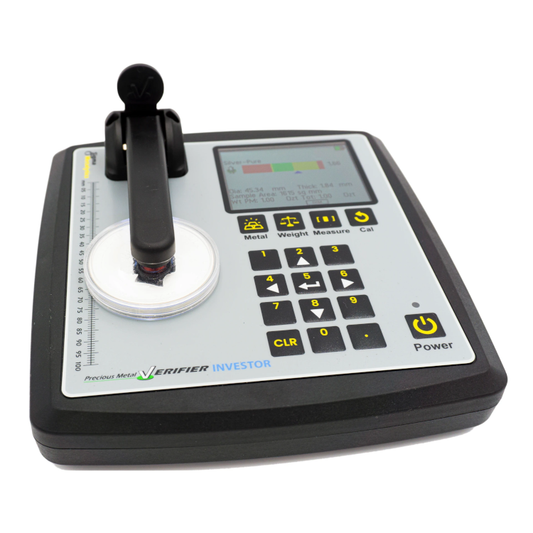
Gold tester for coins and bars
If you've typed "gold tester" into Google, most of what came up will have been for jewellers: acid kits and electronic pens that tell you whether a ring is 9ct or 18ct. That isn't what we do. Our machines are for bullion, i.e. coins and bars, and they won't test jewellery at all.
We're asked about rings, chains and scrap a lot, and the answer is always no. For jewellery you want an XRF, acid, or somebody with experience. For coins, bars and bullion you want a verifier. It's the right tool for the right job.
So this page is for you if you're holding a Sovereign, a Britannia, a Krugerrand, a 1oz bar or a kilo of silver (or you're about to buy one) and you want to know it is what it says it is.
What a gold tester actually tells you
A Sigma Metalytics Precious Metal Verifier measures resistivity, which is how much a metal resists a small electrical current. Each alloy has a characteristic figure. The sensor puts a small electromagnetic field into the coin or bar, measures what comes back, and compares it with the setting you've chosen, for example "Gold Sovereign" or "Pure Gold". There's a lot of maths behind it, but that's the short version.
Green means the metal is consistent with that setting. Red is a warning. (The Original shows brackets and an X in place of the colours.)
It's worth being clear about what that means. The machine doesn't give you a read-out of what something is made of, and it doesn't measure purity. It tells you whether your piece behaves like the alloy it's supposed to be, so you need to know what it's supposed to be before you start.
A green reading alone is only half the story. When a counterfeiter sets out to fake a coin or bar they can go one of two routes: copy the way the metal reads on a resistivity test, or copy its density. It's much harder to do both. Certain brass alloys read very close to pure gold, for example, but brass is about half as dense, so a copy made from it comes out noticeably oversized.
That's why the reading and the density go together. The Investor and the Pro do the density part for you: you key in the weight and the machine works out the size the piece should be. With the Original you do it yourself with scales and a calliper.
"It didn't stick to the magnet, so it must be real"
We hear this one a lot! Copper doesn't stick to a magnet. Neither does tungsten. A magnet will catch the crudest fakes and that's about it.
Weight is better, and so is measuring the coin, albeit a well made fake gets both of those right. You can watch one do it: Backyard Bullion hides a fake half Sovereign among his own. It weighs right and passes the size check, and the Pro still picks it out (6 minutes in).
Acid and XRF machines are a different matter, and we don't want to be disparaging about either. An XRF is still the best thing there is for working out what an unknown piece is made of. From our understanding though, it only reads the very top layer of the metal, a hundredth or two of a millimetre on gold, and an acid or scratch test only looks at the surface as well. If the outside is real gold, that's what they'll tell you.
The fake we keep in the office
For context, the best fake we have come across is a 1oz gold Maple, which we still have. In January 2026 we took it, along with a genuine one, to a jewellery shop with a top of the range desktop XRF. The XRF passed the fake as real. It passes a density test done by hand as well. On the Pro it fails straight away, as it reads all the way through the coin.
We call these "mega-fakes": thick gold plating and accurate density.


The same coin on both machines. The XRF reads it as 24ct gold, then the Pro flags it.
The whole test, start to finish. There is no sound.
When I've bought on eBay myself, I tell the seller beforehand that I'll be checking the piece on my Sigma, and I only buy from people with hundreds of successful transactions.
Which one do you need?
This is the question we're asked more than any other. The question to ask yourself is what range of pieces you own, or plan to trade in.
1) Gold coins and smaller gold bars (up to about 100g), and silver up to 10oz: the Investor. It reads all the way through pieces up to 10mm thick and does the density check for you. If you're testing any gold at all, I'd generally lean towards the Investor over the Original. It's about the size of two smartphones side by side, so it goes to a coin fair or an auction with you.
2) Silver rounds only, on a tight budget, and you're happy to do a density check by hand on every piece: the Original. Its sensor reads just under the surface and it has no density test built in. We often have people buy an Original because they've seen one on a US YouTube video, only to trade up to the Investor a few months later. An Original can't be upgraded, so it's worth thinking about what you might own in a few years' time.
3) Large numbers of coins, day in, day out: the Pro. It's built for speed in regular use, reads through pieces up to 12.5mm thick and has a full keypad. For most people it wouldn't add anything over the Investor.
4) 1kg and 100oz silver bars, and gold bars up to 400oz: the Pro with External Bridge, which reads through bars up to 45mm thick. It's thickness that decides here, not weight. I've seen kilo bars 8mm thick (as well as 18mm!), so measure the bar before you choose. The Bridge is for bars from 12mm thick, and thinner ones go on the Pro's own sensors.
If the dearer machine would be overkill for what you hold, we'll tell you. Let us know what you've got and we'll say which one fits.
What it won't do
It won't test jewellery of any kind. Sigma say so themselves.
It won't identify a mystery metal. You can't run a piece through every setting to see which one it passes.
The piece has to cover the sensor, and it needs something flat to read. Right near the edge, or over a raised design, the reading can be distorted, so test on a flat part in the middle. Very small pieces, a 1 gram bar for example, are too small for the main sensor and need one of the wands, and the wands only read just under the surface.
It reads through most capsules, slabs and card, so you don't have to take a coin out. A couple of really thick casings can interfere, as can any case with metal in it, and generally the smaller the piece and the thicker the casing, the harder it is to get a good reading. Coins aren't always centred in a slab either, so try it from both sides.
A few genuine coins are known to read outside the range, some 2018 gold Eagles for example, and Sigma publish a list of them. Very old coins can do the same, as mints weren't always great at cleaning out contaminants. In those cases go on the weight, size and markings.
Sovereigns dated 2026 are a new alloy. New machines have had a setting for them for many months. If yours is older and hasn't been updated, use the Gold Britannia 1990-2012 setting.
Sigma's own manual says a verifier shouldn't be the only check you rely on, and we'd say the same. Used with a set of scales and a calliper, it's a much stronger defence than any one test.
Questions we get asked
Will it mark my coin?
No. There are no chemicals and nothing is scratched or filed.
Does it do silver as well?
Yes. There are settings for silver, platinum and palladium as well as gold, including the common coins: Sovereigns, Britannias, Krugerrands, Maples, Eagles and so on.
How long does a test take?
Moments. You put the coin on the sensor and the reading comes up.
What does a yellow reading mean?
It's a common concern, and yellow isn't a fail. It could be tiny contaminants or variations in that batch, and 99.9% silver often reads yellow where 99.99% reads green. Do the density check. If it was in the yellow and failed that as well, then we'd have a problem!
What if it reads red?
Red doesn't always mean a counterfeit. Check the setting first: an American Gold Eagle needs its own setting, for instance, and won't read properly on the other 22ct ones. Make sure the coin and the machine are at the same room temperature (gold warms up very quickly in the hand) and keep phones and wifi routers away from it, as they can make the pointer jump. Then test again on a flat part and check the weight and size. If it still fails, speak to whoever sold it to you.
You can watch this happen in Backyard Bullion's review of the Investor: a 22ct coin sits in the red on the general 22ct setting, and goes green once he picks the Britannia setting (16 minutes in).
Is there a warranty?
A two-year limited warranty from Sigma Metalytics.
Can I see one working before I buy?
Yes, by appointment with us in Hull, or we can send you a video.
Any questions; we're a family business and we're on hand until late, 7 days a week. Get in touch.
Our range of Sigma Metalytics products:
-
Sigma Metalytics Investor
Vendor:Sigma MetalyticsRegular price £1,479.00 GBPRegular price£1,500.00 GBPSale price £1,479.00 GBPSale -
Sigma Metalytics Original
Vendor:Sigma MetalyticsRegular price £830.00 GBPRegular price£875.00 GBPSale price £830.00 GBPSale -
 Sale
Sigma Metalytics Pro
Vendor:Sigma MetalyticsRegular price £1,999.00 GBPRegular price£2,200.00 GBPSale price £1,999.00 GBPSale -
 Sold out
Sigma Metalytics PRO Mini
Vendor:Sigma MetalyticsRegular price £1,415.00 GBPRegular price£1,415.00 GBPSale price £1,415.00 GBPSold out