How to tell if gold is real (coins and bars)
There's no one test that will tell you a gold coin or bar is real. A genuine piece should be right on the markings, the weight, the size and the metal itself. It's much harder for a fake to manage every one of those, so the way to catch one is to check more than one thing.
This page is about bullion, i.e. coins and bars. If it's a ring or a chain you're wondering about, that's a job for a jeweller, and none of what follows is meant for jewellery.
We sell the machines in step 6. You don't need a machine at all for the first four.
1) Start with who's selling it
"If a deal is too good to be true, it probably is!" That's from Sigma's own manual and we'd say the same.
When I've bought on eBay myself, I tell the seller beforehand that I'll be checking the piece on my Sigma, and I only buy from people with hundreds of successful transactions.
2) Look at it properly
Put it next to one you know is genuine, or the mint's own pictures, and compare the design, the lettering, the edge and the finish.
It's worth doing, albeit not enough on its own.
3) The magnet
"It didn't stick to the magnet, so it must be real." We hear this one a lot!
Gold isn't magnetic, so if a piece does stick you have your answer. If it doesn't stick you've learnt very little, as copper doesn't stick to a magnet and neither does tungsten. A magnet will catch the crudest fakes and that's about it.
4) Weigh it and measure it
This is the check anybody can do, and it's half the picture. You need a calliper and a set of scales, ideally ones that read to two decimal places of a gram.
Weigh the piece, measure its diameter and its thickness, then compare them against the published figures for that coin and year. Measure the thickness at the rim, as that's how the mints do it. The mint that struck the coin will usually publish the weight and the diameter, though not always the thickness. Sigma's coin reference guide lists weights and dimensions for many popular coins as well, though it's written for the US market.
To give you an idea of how close it should be: for a 2013 Krugerrand, Sigma give 33.93 grams, give or take 0.05, with a diameter of 32.8mm and a thickness of 2.84mm at the rim.
Older coins can be a little light from wear. The Royal Mint gives a Sovereign as 7.98g (7.99g on some of its newer pages) and 22.05mm across, and the pre-owned ones it sells weigh at least 7.93787g each. That's its cut-off for what it sells and I wouldn't use it as a pass mark either way. A coin a few hundredths of a gram light isn't wrong for that alone, and the right weight on its own doesn't make a coin genuine. The size and the metal still have to be right.
Bars are checked the same way, on thickness, length and width. They're harder to measure when they're sealed in an assay card, and Sigma's manual warns that counterfeit gold bars in assay cards are frequently the wrong thickness, so measure what you can. Don't open the card to do it.
The reason it works is that most cheaper metals are a good deal less dense than gold, so a copy made from one of them can't be the right weight and the right size at once. Certain brass alloys read very close to pure gold on a resistivity test, for example, but brass is about half as dense, so a copy made from it comes out noticeably oversized.
Where it falls down is a fake that has been made to the right density. The best one we have come across is a 1oz gold Maple, which we still have, and it passes a density test done by hand.
5) Acid and XRF
We don't want to be disparaging about either. If you need to know what an unknown piece is made of, an XRF is still the best thing there is.
From our understanding though, an XRF only reads the very top layer of the metal, a hundredth or two of a millimetre on gold, and an acid or scratch test looks at the surface as well. If the outside is real gold, that's what they'll tell you.
We've seen it with our own Maple. In January 2026 we took it, along with a genuine one, to a shop with a top of the range desktop XRF. The XRF passed the fake as real.
The same coin on both machines. The XRF reads it as 24ct gold, then the Pro flags it. There is no sound.
6) A verifier
This is the part we sell, and it has its limits.
A Sigma Metalytics verifier measures resistivity, i.e. how much the metal resists a small electrical current, and compares it with the setting you choose, so you need to know what the piece is supposed to be before you start.
How deep it reads depends on the model. The Investor reads all the way through pieces up to 10mm thick and the Pro up to 12.5mm. The Original's sensor reads just under the surface, not all the way through, and it has no density test built in. Very small pieces, a 1 gram bar for example, go on a wand whichever model you have, and the wands only read just under the surface too.
Our Maple fails on the Pro straight away.
It tells you about the metal. It can't tell you who made the piece, so it still matters who you buy from. It won't test jewellery either. And Sigma's own manual says it shouldn't be the only check you rely on.
Sigma give an example of why. In 2021 they found a fake 2013 Krugerrand that read within the range on an Original. They say it was close in size and weight but not exactly right, and they recommend checking 2013 Krugerrands against the published size and weight. So the reading and the measurements go together.
There's more on our gold tester page, including which model fits what you hold.
What each check tells you
| Check | What it tells you | What it can't |
|---|---|---|
| Magnet | Whether the piece is magnetic. Gold isn't | Whether a piece that doesn't stick is gold |
| Scales and calliper | Whether it's the right weight for its size | Whether the metal is right, if the density has been matched |
| Acid or scratch test | What the surface is | What's underneath |
| XRF | What the top layer is made of. It's the best of these for working out what an unknown piece is | What's under a thick enough gold layer. Our fake Maple passed one |
| Verifier, with the scales and calliper | Whether the metal reads like the alloy it should be. All the way through on an Investor or Pro, if the piece is thin enough and covers the sensor. Just under the surface on the Original and the wands | Who made it. You have to know what the piece is meant to be |
What about the ping test?
You'll also read about the ping test, vinegar, bleach and scratching a coin on a tile. We've nothing first-hand to add on the ping, so I'll leave that to others. Sigma's advice is never to damage a piece in any way, and I'd leave well alone anything that scratches or marks a bullion coin.
If something doesn't add up
One odd result can be a slip, so check your figures and measure again.
If it's the verifier reading that's off, check the test before you blame the coin: the setting, the temperature of the coin and the machine, a flat part in the middle, and any thick casing. There's more on that on the gold tester page.
One exception is a short list Sigma publish of genuine coins that read oddly on a verifier, some 2018 gold Eagles for example. For those, their rule of thumb is that a coin of the right size and weight, with the right markings, that isn't magnetic, is likely genuine if it reads near the range. That's for the coins on their list and it isn't a general pass.
If it's still wrong after that, treat the piece as suspect and speak to whoever sold it to you. Sigma's own guidance is that a genuine piece should pass every test it's put through.
Questions we get asked
Does real gold stick to a magnet?
No. Copper and tungsten don't either though, so a piece that doesn't stick hasn't been shown to be gold.
Can I tell if gold is real at home?
You can get a good way with scales, a calliper and the published figures. What scales and a calliper can't tell you is what the metal is under the surface.
How do I tell if a gold bar is real?
The same way: markings, weight, size and the metal. With a bar, measure the thickness first. A verifier only reads all the way through up to a certain thickness: 10mm on the Investor, 12.5mm on the Pro, and with the External Bridge, bars from 12mm to 45mm thick and at least 50mm wide. It reads through most assay cards, so there's no need to open one.
How do I tell if a Sovereign is real?
Weigh it and measure it across, and compare both with the Royal Mint's figures. The Royal Mint's pages don't give a thickness, so put it next to a Sovereign you know is genuine if you can. Then check the metal. Sovereigns dated 2026 are a new alloy, so on a verifier they need the right setting. There's more on the gold tester page.
Do I need a machine?
Not necessarily. It depends what you hold and where you buy it. We certainly don't want you having a device that just sits on the shelf, so tell us what you've got and we'll give you a straight answer.
Any questions; we're a family business and we're on hand until late, 7 days a week. Get in touch.
Nuestra gama de productos Sigma Metalytics:
-
 Oferta
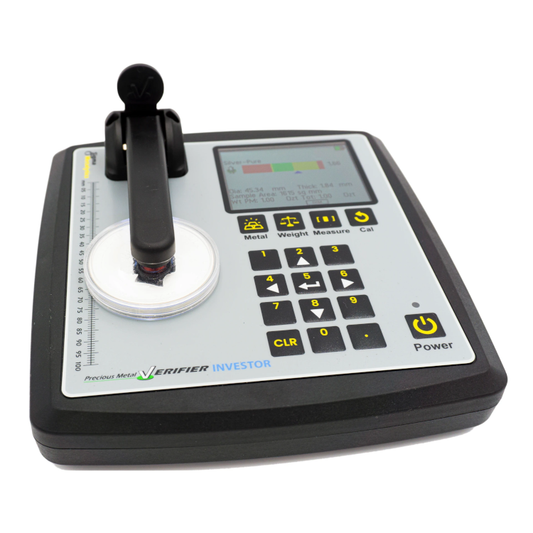
Sigma Metalytics Investor
Proveedor:Sigma MetalyticsPrecio habitual £1,479.00 GBPPrecio habitual£1,500.00 GBPPrecio de oferta £1,479.00 GBPOferta -
 Oferta
Sigma Metalytics Original
Proveedor:Sigma MetalyticsPrecio habitual £830.00 GBPPrecio habitual£875.00 GBPPrecio de oferta £830.00 GBPOferta -
 Oferta
Sigma Metalytics Pro
Proveedor:Sigma MetalyticsPrecio habitual £1,999.00 GBPPrecio habitual£2,200.00 GBPPrecio de oferta £1,999.00 GBPOferta -
 Agotado
Sigma Metalytics PRO Mini
Proveedor:Sigma MetalyticsPrecio habitual £1,415.00 GBPPrecio habitual£1,415.00 GBPPrecio de oferta £1,415.00 GBPAgotado


