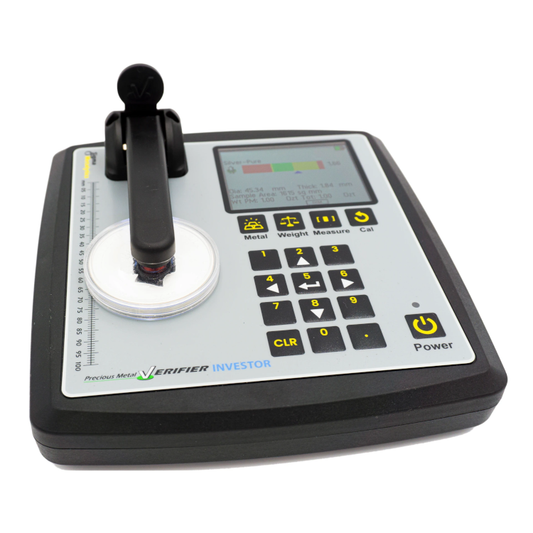
Silver tester for coins and bars
Most of what comes up for "silver tester" is acid: a bottle of solution and a stone, made for jewellery and cutlery. That isn't what we do. Our machines are for silver bullion, i.e. coins, rounds and bars, and they won't test jewellery or cutlery at all.
So this page is for you if you stack silver, whether that's a tube of Britannias, a few 10oz bars or a kilo, and you want to know it is what it says it is.
How it tests silver
A Sigma Metalytics Precious Metal Verifier measures resistivity, i.e. how much a metal resists a small electrical current. You choose the setting for what the piece is supposed to be (99.9% silver, say, or a Silver Britannia), put it on the sensor, and the machine tells you whether it behaves like that alloy.
On the Investor and the Pro, green means consistent, yellow means slightly off and red is a warning. The Original shows brackets, a star and an X in place of the colours.
That's half the story. The other half is density: does the piece weigh what it should for its size? The Investor and the Pro work that out for you once you key in the weight. With the Original you do it yourself with scales and a calliper.
The machine doesn't measure purity and it won't tell you what an unknown piece is made of, so you need to know what it's supposed to be before you start.
A fake "1oz" silver coin on the Investor: red on the reading, then too big for its weight on the size check. A genuine coin goes on in between. Filmed by Backyard Bullion.
Why your silver reads yellow
It's a common concern when people see results in the yellow.
On the Pro range (the Investor and the Pro), a 99.9% piece tested on the pure silver setting will often read in the yellow, where 99.99% silver, a Maple for example, reads green. Britannias from 2013 onwards and Eagles are 99.9%. Sigma calibrate it that way on purpose. In their words the yellow is a caution sign, there to remind you to check the size, weight and markings as well.
So a yellow on a 99.9% coin or bar isn't a fail. Sigma's guidance is that if the piece is the right size and weight, has the right markings and isn't magnetic, it is likely genuine. With my own coins, a yellow simply means I go on and do the dimensions test as well. If it was in the yellow and failed that too, then we'd have a problem!
A 99.9% coin on the 99.99% setting. It reads red in its capsule, and between yellow and green once it's out, which is normal. Filmed by Backyard Bullion.
If your machine has a separate setting for 99.9% silver, or one for the coin itself, use that.
"It slid down the magnet slowly, so it's silver"
The slide test is a popular one with silver: a strong magnet slides slowly down a genuine bar. The trouble is that copper can fool it. The slow slide comes from how well the metal conducts, and copper conducts nearly as well as silver, so a copper bar slides slowly too.
Copper is a good deal lighter than silver though, so weighing and measuring the piece will show it up. That's the half of the test you should always do anyway.
An acid or scratch test only looks at the surface. If the outside is real silver, that's what it'll tell you, and it means marking the piece.
Bars: measure the thickness first
With the bigger silver bars it's thickness that decides which machine you need, not weight.
The Pro's own sensors read all the way through pieces up to 12.5mm thick. The External Bridge takes over from 12mm and reads through bars up to 45mm thick, as long as they're at least 50mm wide. The average kilo bar is around 15mm thick, so it needs the Bridge, albeit I've seen kilo bars 8mm thick (as well as 18mm!). Measure yours before you choose.
A typical 100oz bar is the same story. To read all the way through one you need the Bridge. On the Pro alone you'd be testing it with a wand, and the wands only read just under the surface.
5kg bars are a different matter. The average one is about 51mm thick and the Bridge stops at 45mm, so find out the height of the bar before anything else.
Reading all the way through matters on a big bar, as the middle is where a problem can be hidden. Sigma's technical team have told us of large silver bars with a lead or copper rod inserted right in the middle, and of bars with a corner carved out and filled with lead. A rod in the middle can really only be picked up with the External Bridge. A wand on the surface is only giving you part of the picture.
Which one do you need for silver?
1) If you only buy silver rounds, the budget is tight and you're happy to do a density check by hand on every piece: the Original. This is the one case where I'd suggest it over the Investor. Its sensor reads just under the surface and it has no density test built in, so the scales and calliper come out every time. Sigma's manual for the Original calls that check "critically important" on Silver Britannias, Eagles, Libertads and Krugerrands.
2) For coins, rounds and bars up to about 10oz: the Investor. Its sensor reads right through pieces up to 10mm thick and it works out the density for you once you've keyed in the weight. It handles gold coins and smaller gold bars too, which is worth thinking about if you might buy gold one day, as an Original can't be upgraded.
3) For large quantities of coins, or larger bars up to 12.5mm thick: the Pro. It's built for more speed in regular use and has a full keypad.
4) For bars from 12mm to 45mm thick and at least 50mm wide, i.e. the typical kilo bar or 100oz bar: the Pro with External Bridge. The Bridge is overkill unless you're testing 1kg bars, 100oz bars, etc.
If you're not sure, tell us what you hold and we'll point you to the right one.
What it won't do
It won't test jewellery, and that includes chains, rings and the family cutlery. Sigma only recommend it for coins and bars. An XRF, an acid test or an experienced eye is the right route for those.
The piece has to cover the sensor circle. Anything smaller goes on one of the wands, and a wand can't do the density check.
There are settings for sterling (92.5%) coins and for 90% US coin silver. I'd take results on older coins with a pinch of salt, some US coins well into the 1900s included, as mints weren't always great at cleaning out contaminants.
Silver Britannias changed in 2013. Those from 1997 to 2012 are 95.8% silver and have their own setting, so check the date before you choose one.
Sigma publish a list of genuine pieces that read oddly. US silver dollars from 1921, 1923 and 1928 are on it (they need the pre-1900 setting), as are some older silver bars that read outside the range. Sigma's manual also mentions private mint bars from the 1980s, 10oz and 100oz ones especially. Their advice on bars like those is that a piece reading near the range is likely genuine if the size, weight and markings are right and it isn't magnetic.
Sigma's manual says a verifier shouldn't be your only check, and I'd strongly recommend always doing the density check as well.
Questions we get asked
Will it mark my silver?
No. It's an electronic test with no chemicals, and nothing is scratched or filed.
Does it do gold as well?
Yes, and platinum and palladium. There's more about gold on our gold tester page.
Can a coin stay in its capsule?
In most cases, yes. Capsules, slabs and card don't usually get in the way. A thick casing can throw the reading off, as in the second clip above, and so can any case with metal in it. If a coin reads oddly in its capsule, take it out and test it again. With a slab, turn it over, as coins aren't always centred in the plastic.
How do I do a density check by hand?
Weigh the piece and measure its diameter and thickness with a calliper, then compare them against the published figures for that coin and year. Sigma's coin reference guide lists the weights and dimensions of the common coins.
What if it reads red, or shows an X on the Original?
It isn't necessarily a fake. Check the setting first: the machine may have been left on a gold setting from the last test, or be on the wrong Britannia setting for the date. Then let the coin and the machine settle at the same room temperature, move your phone and the wifi router away, and try again on a flat part in the middle. If it still fails, check the weight and size and go back to whoever sold it to you.
Is it worth it for a few coins?
That depends on what you hold and where you buy it. We certainly don't want you having a device that just sits on the shelf, so tell us what you've got and we'll give you a straight answer.
Every machine carries Sigma's two-year limited warranty, and you're welcome to see one working before you buy, by appointment with us in Hull or on a video.
Any questions; we're a family business and we're on hand until late, 7 days a week. Get in touch.
Unser Sortiment an Sigma Metalytics-Produkten:
-
Sigma Metalytics Investor
Anbieter:Sigma MetalyticsNormaler Preis £1,479.00 GBPNormaler Preis£1,500.00 GBPVerkaufspreis £1,479.00 GBPSale -
Sigma Metalytics Original
Anbieter:Sigma MetalyticsNormaler Preis £830.00 GBPNormaler Preis£875.00 GBPVerkaufspreis £830.00 GBPSale -
 Sale
Sigma Metalytics Pro
Anbieter:Sigma MetalyticsNormaler Preis £1,999.00 GBPNormaler Preis£2,200.00 GBPVerkaufspreis £1,999.00 GBPSale -
 Ausverkauft
Sigma Metalytics PRO Mini
Anbieter:Sigma MetalyticsNormaler Preis £1,415.00 GBPNormaler Preis£1,415.00 GBPVerkaufspreis £1,415.00 GBPAusverkauft