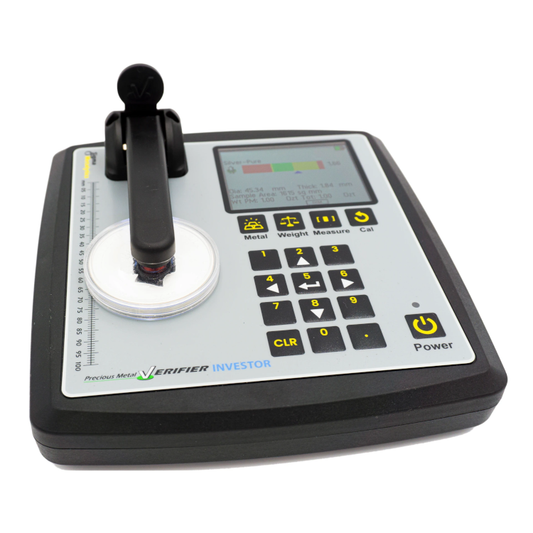
Precious metal tester for coins and bars
People mean different things by "precious metal tester". It might be an acid kit or an electronic pen, which are made for jewellery, or an XRF analyser. What we sell is a verifier, which is a different thing again.
Ours are for bullion, i.e. coins and bars in gold, silver, platinum and palladium, and they won't test jewellery at all. So this page is for you if you hold bullion, or deal in it, and want to know a piece is what it says it is.
We're Trusti Metrix, a family business in Hull and the exclusive UK distributor for Sigma Metalytics.
Tester, analyser or verifier?
An XRF tells you what a piece is made of. It's still the best thing there is for an unknown piece, albeit from our understanding it only reads the very top layer of the metal.
A verifier checks whether a piece is what it's meant to be. You choose the setting for what it should be (a Gold Sovereign, say, or pure platinum), put the piece on the sensor, and the machine tells you whether the metal behaves like that alloy. It doesn't give you a read-out of what's in the piece and it doesn't measure purity, so you need to know what it's supposed to be before you start.
Sigma Metalytics call theirs the Precious Metal Verifier, or PMV for short. The first one came out in 2013.
How it tests
A verifier measures resistivity, i.e. how much a metal resists a small electrical current. Each alloy has a characteristic figure, and the machine compares your piece with the setting you've chosen.
On the Investor and the Pro, green means consistent, yellow means slightly off and red is a warning. The Original shows brackets, a star and an X in place of the colours.
That's half the story. The other half is density: does the piece weigh what it should for its size? A counterfeiter can copy the way a metal reads, or copy its density. It's much harder to do both, so the two checks go together. On the Investor and the Pro you key in the weight and the machine works out the size the piece should be. With the Original you do the whole check yourself with scales and a calliper.
Which metals it covers
1) Gold. Pure gold and the common coin alloys, with settings for Sovereigns, Britannias, Krugerrands, Eagles and Maples. There's more on our gold tester page, including the fake Maple we keep in the office.
2) Silver. Pure silver, sterling and 90% coin silver, plus the older Britannias. Our silver tester page covers why 99.9% silver often reads yellow and what to measure on a kilo bar.
3) Platinum. The setting is for pure platinum only, 99.9% and above. Platinum is dense, so the coins and bars are usually quite thin. If one won't give a good reading, Sigma suggest putting the calibration disk behind it, or trying a smaller sensor.
4) Palladium. Again, 99.9% and above. Platinum and palladium read very much alike on resistivity. Platinum is a good deal denser though, so it's the weight and size that tell the two apart.
There are settings for rhodium and for pure copper as well. Some rhodium bars need their own setting, so ask us if you have one.
See it working
A fake half Sovereign, mixed into a bag of genuine ones, turns up on the Pro. It reads red, a genuine one put on straight after reads green, and the fake reads red again. The clip joins two moments from a video we sponsored, made by Backyard Bullion.
The full video has the weight and size checks as well.
There are more on our YouTube channel, including a fake gold Maple that passed an XRF, which we filmed ourselves, and a fake silver coin on the Investor from Backyard Bullion, who has made sponsored videos with us since 2024.
Which model do you need?
It depends what you hold. With bars, measure the thickness first, as that matters more than the weight.
| Model | How deep it reads | What it suits |
|---|---|---|
| Original | Just under the surface | Silver rounds, if you're happy to do the density check by hand on every piece. For gold we'd point you to the Investor |
| Investor | All the way through, up to 10mm thick | Gold coins and smaller gold bars, and silver up to about 10oz |
| Pro | All the way through, up to 12.5mm thick | Large numbers of coins in regular use, and bars up to 12.5mm thick |
| Pro with External Bridge | All the way through: up to 12.5mm on the Pro's own sensors, and on the Bridge, bars from 12mm to 45mm thick and at least 50mm wide | The typical 1kg or 100oz silver bar, and gold bars up to 400oz |
For gold I'd generally lean towards the Investor over the Original, and bear in mind an Original can't be upgraded later to read all the way through.
If a bigger machine would be overkill for what you hold, we'll say so. Let us know what you've got and we'll point you to the right one.
What it won't do
It won't test jewellery of any kind, and that includes rings, chains and scrap. Sigma only recommend it for coins and bars.
It shouldn't be the only check you rely on either. Sigma's own manual says so, and we'd say the same.
The gold and silver pages go into the limits for each metal.
Questions we get asked
Is a precious metal tester the same thing as a Precious Metal Verifier?
Precious Metal Verifier is Sigma's name for their machines. People call them testers, bullion testers, checkers, all sorts. An analyser usually means an XRF, which does a different job.
Does it test platinum and palladium?
Yes, on every model, as long as the piece is 99.9% or above and thick enough for the sensor. Sigma's tip for thin platinum is further up this page. Platinum of a lower purity is rare and can't be tested.
How do I know the machine itself is reading properly?
Every machine comes with an aluminium calibration disk and has a setting for it. Put the disk on the sensor and it should come up green, or in the brackets on the Original (a step or two off centre is normal). If it doesn't, get in touch with us.
Will it mark the piece?
No. It's an electronic test, with no chemicals and nothing scratched or filed.
Can a coin stay in its capsule?
In most cases, yes. A thick casing can throw the reading off, and so can any case with metal in it, so if a coin reads oddly in its capsule, take it out and test it again.
Is there a warranty?
A two-year limited warranty from Sigma Metalytics. If a machine needs looking at, it comes back to us in Hull.
Can I see one working before I buy?
Yes, by appointment with us in Hull, or on a video.
Any questions; we're a family business and we're on hand until late, 7 days a week. Get in touch.
Unser Sortiment an Sigma Metalytics-Produkten:
-
Sigma Metalytics Investor
Anbieter:Sigma MetalyticsNormaler Preis €1.699,00 EURNormaler Preis€1.900,00 EURVerkaufspreis €1.699,00 EURSale -
Sigma Metalytics Original
Anbieter:Sigma MetalyticsNormaler Preis €854,00 EURNormaler Preis€999,00 EURVerkaufspreis €854,00 EURSale -
 Sale
Sigma Metalytics Pro
Anbieter:Sigma MetalyticsNormaler Preis €2.299,00 EURNormaler Preis€2.400,00 EURVerkaufspreis €2.299,00 EURSale -
 Ausverkauft
Sigma Metalytics PRO Mini
Anbieter:Sigma MetalyticsNormaler Preis €1.730,95 EURNormaler Preis